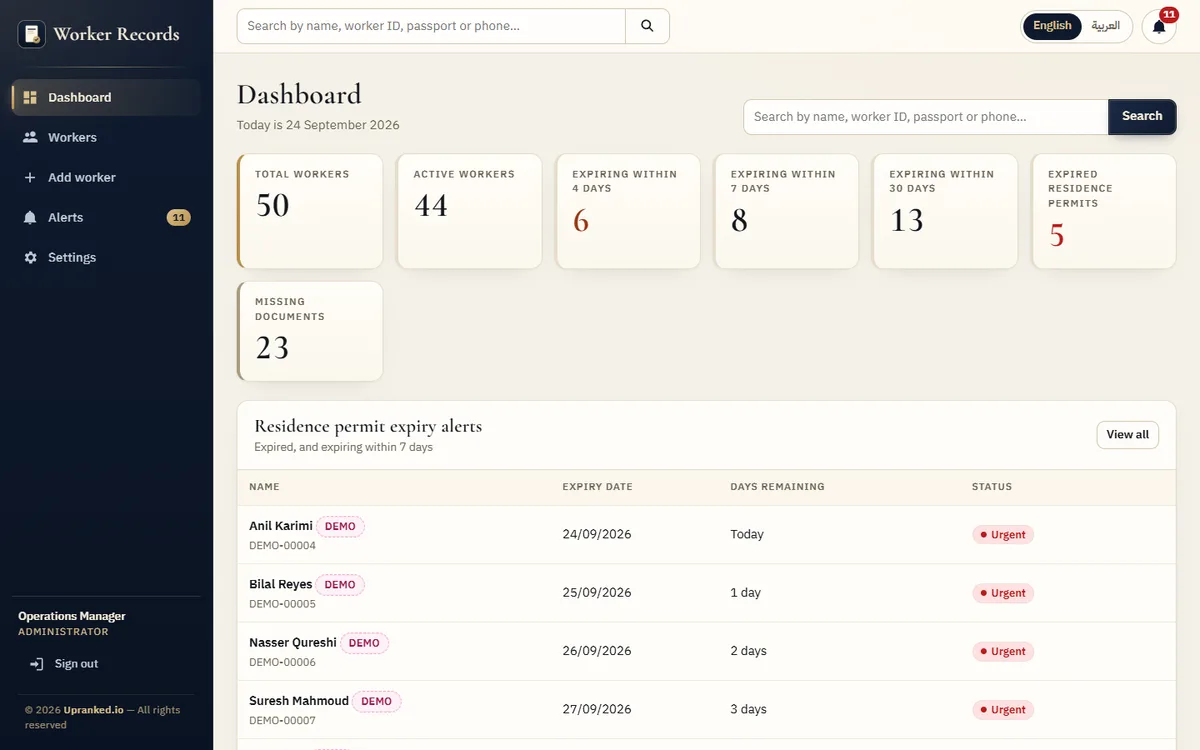
Nobody decides to let a residence permit expire. It happens because the person who kept the file was on leave, or because two copies of the spreadsheet stopped agreeing, or because a worker joined mid-month and was written on paper with every intention of adding them properly later. The failure is administrative, not moral — which is exactly why telling people to be more careful does not fix it.
What follows is worth understanding before it happens to you, because the consequences land on the employer more than most employers expect.
Who is actually responsible
In the UAE the sponsoring employer holds the obligation to keep an employee's residence permit valid. That is the part businesses most often get wrong in conversation — there is a tendency to treat renewal as something the employee should be chasing. Legally and practically, the sponsor carries it. The current requirements and procedures are published on the UAE Government portal, and they are the authority worth checking rather than anything you read second-hand, including this article.
That matters for how you organise the work internally. If responsibility sits with the company, then the tracking has to sit with the company too — not distributed across the memories of the people it concerns.
What happens once the date passes
Three things start at once, and they compound.
- Financial penalties begin accruing. They are set by the immigration authorities, they are counted per day, and they do not pause while you organise the paperwork.
- The employee's legal status changes. Depending on the role and the sector, that can mean they cannot lawfully remain on site — which is an operational problem before it is an administrative one.
- The renewal itself becomes harder. A routine renewal handled in advance is a different process, with different paperwork, from one handled after a lapse.
Deliberately, there are no figures in that list. Penalty amounts are set by the authorities and change; quoting a number here would be the kind of detail that is confidently wrong a year from now. Check the official source for the current position.
Why the cost is bigger than the fine
The fine is the visible cost and usually the smallest one. What actually hurts is the scramble: someone stops doing their job for two days, a site runs short-handed, a manager spends an afternoon at a typing centre, and the relationship with the employee takes a knock they did not deserve. None of that appears on an invoice.
There is a reputational edge to it as well. In sectors where inspections happen — healthcare, construction, facilities, food — a lapse found by an inspector is a different conversation from a lapse you caught yourself.
Why spreadsheets keep losing this race
A spreadsheet is a good place to record that a permit expires on a date. It is a poor place to find out that it did. The distinction sounds pedantic and it is the whole problem: nothing in a spreadsheet reaches out to you. The system depends on a human opening the right file, filtering the right column, and doing it often enough — in a week where forty other things are also urgent.
So the failure modes are predictable, and they are always the same handful:
- The file lives with one person, and that person takes leave
- Someone copies it to work offline, and now two versions disagree
- A new joiner is recorded on paper first, intending to transfer it later
- The column exists but nobody has filtered it since March
- Documents are stored somewhere else entirely, so the record and the evidence drift apart
The honest test: if the person who keeps your expiry records were unreachable for two weeks, would anyone notice a permit approaching its date? If the answer is no, the problem is the method, not the person.
What actually prevents it
Three things, in order of how much they matter.
1. One record per person, with the document attached
Permit, passport, labour card, contract, medical — in one place, with the scan attached to the record rather than filed in a folder someone else organised. Splitting the date from the evidence is how the two end up disagreeing.
2. A warning that arrives, rather than one you have to go and look for
This is the part a spreadsheet structurally cannot do. The notice needs to reach the person who can act on it, on the device they actually use, with enough runway for the process it triggers. A renewal needing a medical and a typing centre visit needs more notice than one you handle in-house — so the lead time should reflect your process, not a default someone picked.
3. Visibility of what is missing, not only what is expiring
Gaps are quieter than expiries and more dangerous. A worker whose passport copy was never uploaded does not show up on any expiry report, because there is no date to expire. The absence has to be surfaced deliberately.
When it is worth building something
If your headcount is small enough that one person genuinely holds it all in their head, you probably do not need software yet, and anyone telling you otherwise is selling. It starts earning its place around the point where you can no longer name every expiry date from memory — usually somewhere in the tens of people, earlier if you are tracking several document types each.
We have built exactly this: a bilingual system holding every worker record and document, warning four days before a permit expires both in the app and by phone notification, printing a complete record in Arabic or English, and backing itself up off-site nightly. The detail is on the permit and document tracking page, and the result is in Real Results.
Worth knowing: underneath, it is not really a permits system. It is a system for anything with a document, an owner and a date it stops being valid — trade licences, vehicle registrations, equipment certificates, professional licences, client contracts. If that describes something you currently track by hand, the same shape fits.