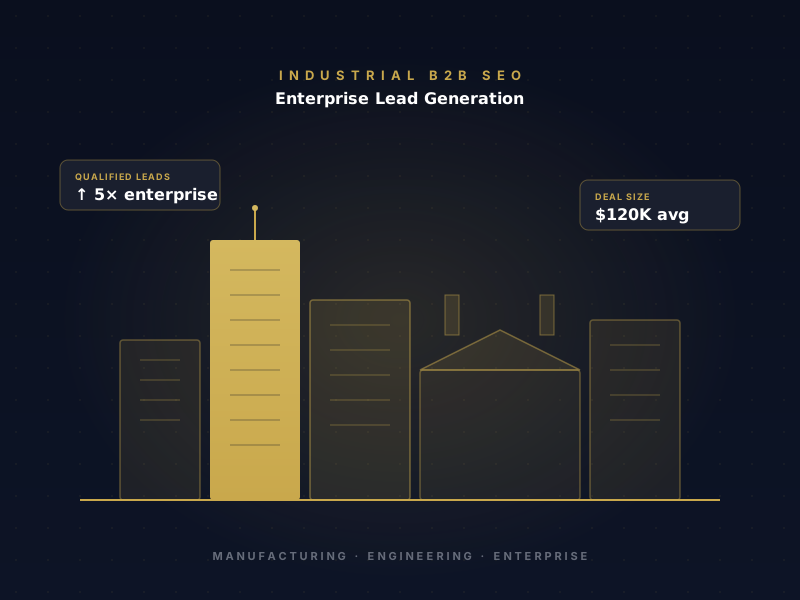
Here is a fact that surprises most industrial business owners in the GCC: the procurement manager shortlisting vendors for a million-dirham contract almost certainly Googled your category before contacting anyone. If you didn't appear in those results, you weren't on the shortlist — regardless of how long you've been in business or how strong your relationships are.
Industrial SEO is not about vanity rankings or website traffic metrics. It's about being findable at the exact moment a procurement decision-maker is actively looking for what you supply.
How Industrial Buyers Actually Search in the GCC
The search behaviour of industrial procurement teams is fundamentally different from consumer or even standard B2B buyers. Their queries are highly specific, deeply technical, and often include:
- Specific product codes or standards: "ASTM A312 stainless steel pipes UAE"
- Certification requirements: "ISO 9001 certified welding contractor Dubai"
- Geographic + service type: "MEP contractor Abu Dhabi industrial zone"
- Comparison searches: "steel vs aluminium scaffolding supplier GCC"
- Application-specific queries: "explosion proof electrical equipment oil gas Qatar"
These keywords often have relatively low search volumes by consumer SEO standards — 50 to 500 searches per month. But each search represents a buyer with a real procurement need, a real budget, and a real timeline. The commercial value per lead in industrial B2B dwarfs consumer categories by orders of magnitude.
Why Most Industrial Companies Are Invisible on Google
The typical industrial company website in the GCC was built as a digital brochure: a home page, an about page, a vague "our services" page, and a contact form. This structure gives Google almost no information to work with when deciding whether to rank you for specific technical queries.
Google ranks pages, not companies. If you don't have a page specifically addressing "fire suppression system maintenance UAE" — with real technical depth, specifications, and geographic relevance — you will not rank for that query, regardless of your company's actual expertise and history.
The Industrial SEO Content Architecture That Works
Product and Service Specification Pages
Every product category and service type you offer needs its own dedicated page with: technical specifications, applicable standards and certifications, geographic coverage, industry applications, and a clear procurement inquiry path. These pages are your ranking assets — each one is a potential entry point from a high-intent search.
Industry Vertical Pages
Rather than one generic "industries we serve" page, build dedicated pages for each sector you work in: oil and gas, construction, manufacturing, utilities, shipping. Each page should demonstrate specific knowledge of that sector's requirements, terminology, and procurement standards.
Technical Resource Content
Procurement managers don't just search for suppliers — they search for specifications, compliance requirements, and technical guidance. Companies that publish genuinely useful technical content (comparison guides, compliance checklists, installation guides) build topical authority that transfers directly to commercial page rankings.
Bilingual Technical Content
Arabic-speaking procurement teams across the GCC — including Emirati government procurement, Saudi Aramco supplier networks, and Kuwaiti industrial operations — frequently search in Arabic for suppliers. Bilingual technical content in Arabic and English captures this segment, which most international industrial suppliers completely ignore.
Local Citation and Google Business Profile for Industrial Companies
Industrial companies often dismiss Google Business Profile as irrelevant ("we're B2B, not a restaurant"). This is a mistake. GBP visibility in industrial free zones, business districts, and geographic searches ("suppliers in Dubai Industrial City", "manufacturers Jebel Ali") drives a meaningful volume of procurement discovery.
Ensuring your company appears correctly in Jebel Ali, KIZAD, KEZAD, King Abdullah Economic City, and other major industrial zone directories — both on Google and in sector-specific databases — builds the citation network that supports your local search authority.
Linking Industrial SEO to Actual Pipeline
The most important metric in industrial B2B SEO is not ranking position or organic traffic — it's RFQ submissions and sales pipeline influenced by organic search. Proper attribution setup (tracking which contact form submissions and phone calls came from which search queries) allows you to calculate the true ROI of your SEO investment and prove it to stakeholders.
The industrial company that becomes the definitive online resource for their product category in the GCC doesn't just get more inquiries — they get better inquiries, from buyers who have already educated themselves and are ready to make a decision.