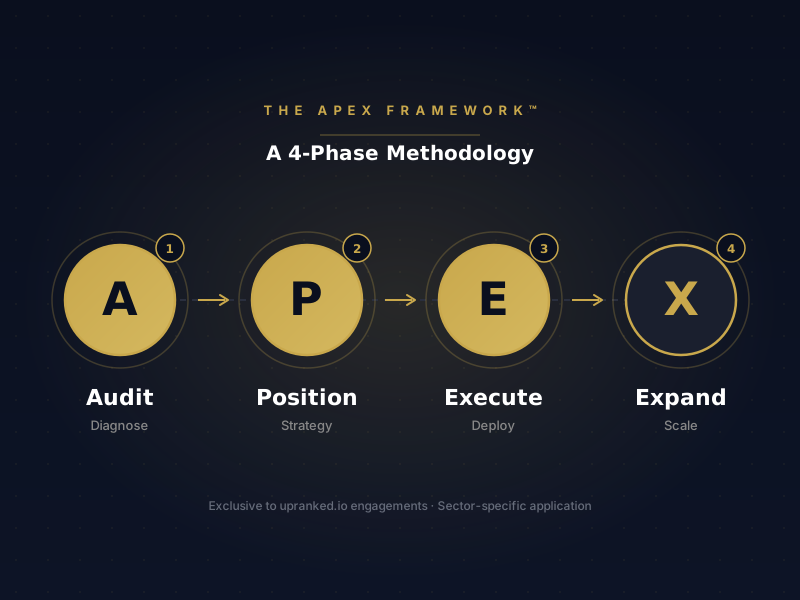
The majority of SEO and digital growth frameworks were developed by US or UK agencies, for US or UK markets. They were then exported to the GCC, where they were applied — sometimes successfully, often not — to a fundamentally different market with different buyer psychology, different search patterns, different regulatory environments, and different cultural expectations.
The APEX Framework™ was developed in reverse: built from the GCC up, informed by years of working specifically with medical practices, industrial B2B companies, professional services firms, and high-value businesses across the UAE, Saudi Arabia, Kuwait, and Qatar.
Phase A — Audit: Intelligence Before Action
Most SEO audits are technical exercises: crawl the site, identify errors, generate a report. The APEX Audit goes significantly further.
The APEX Audit covers five dimensions:
- 1Technical health — crawlability, indexation, Core Web Vitals, mobile performance
- 2Content authority — E-E-A-T signals, topical depth, content quality assessment
- 3Competitive intelligence — who is ranking for your target keywords and why, what they have that you don't
- 4Keyword landscape — commercial intent mapping across English and Arabic, search volume vs. competition analysis
- 5Market positioning — how you are currently perceived versus how you need to be perceived to command premium positioning in search
The Audit output is not a list of technical errors. It is a strategic brief: here is where you stand, here is where your competitors stand, here is the gap, here is the exact opportunity.
Phase P — Position: Competitive Advantage Before Execution
The most common mistake in SEO engagement is jumping from audit to execution without defining the positioning strategy first. The Positioning phase answers: what do you need to be known for, by whom, in which specific geographic and linguistic markets, and what does winning look like in search terms?
For a Dubai specialist clinic, positioning might mean: owning all Arabic-language search for a specific condition in the northern emirates, while building English authority around a specific sub-speciality. For an industrial B2B firm, it might mean: dominant visibility for every product specification query related to one core product category before expanding to adjacent categories.
Positioning also defines the messaging framework — what content needs to say, not just what keywords it needs to include. This is where SEO and brand strategy converge, and where our Growth Intelligence approach distinguishes itself from pure technical SEO.
Phase E — Execute: Compounding Effort, Not One-Time Actions
Execution in the APEX Framework is structured as a compounding programme, not a project. Month 1 fixes create the foundation for Month 3 rankings. Month 3 content creates the authority for Month 6 link acquisition. Month 6 authority unlocks Month 9 competitive displacement.
The Execute phase typically runs across three parallel tracks:
- Technical: resolving all crawl, indexation, and performance issues; implementing schema markup; building the technical architecture for bilingual content
- Content: creating the authoritative pages and articles that match your positioning strategy to your keyword targets
- Authority: building the off-page signals (links, citations, reviews, PR) that tell Google your domain deserves to rank
Phase X — Expand: From Rankings to Market Dominance
The Expand phase is what separates a growth engagement from a maintenance contract. Once core keywords are ranking and organic lead flow is established, the APEX Expand phase identifies the next frontier: adjacent keyword clusters, new geographic markets (expanding from UAE to KSA or Kuwait), new service lines, new languages, new content formats (video, tools, calculators) that capture traffic competitors can't easily replicate.
The goal of the Expand phase is not to maintain a position — it is to make that position progressively more expensive for a competitor to challenge.
Why the APEX Framework Works for GCC High-Trust Industries
Healthcare, industrial B2B, legal, financial services, and professional services share a common characteristic: they operate in industries where Google's quality bar is highest and where client acquisition decisions are driven by trust, not impulse.
Standard SEO frameworks optimise for click volume. The APEX Framework optimises for authority — because in the GCC's high-value sectors, the business that earns the most trust earns the most revenue. Rankings are a symptom of authority, not a goal in themselves.
The APEX Framework doesn't chase Google's algorithm. It builds the kind of digital presence that Google has no choice but to rank highly — because it genuinely is the most authoritative resource in its market.