Bilingual SEO in the GCC — Running Arabic and English as One Strategy
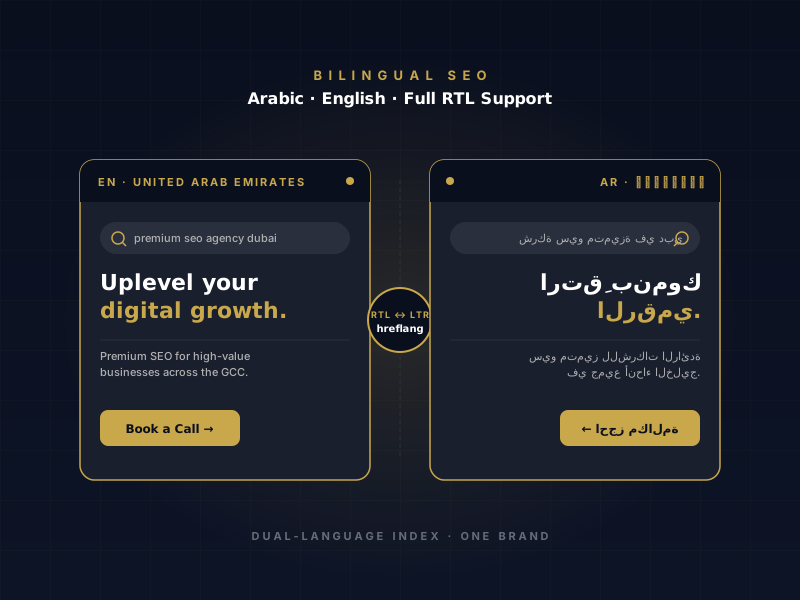
Two languages on one domain is a set of decisions, not a bigger content plan: which language owns which query, how the hreflang cluster is maintained as the site grows, and how budget is split between Arabic and English. upranked.io runs both languages as a single programme for businesses in Dubai, Riyadh, Kuwait City, and Manama.
Definition
Bilingual SEO is the work of running two language versions of one site as a single search programme — in the GCC context, English and Arabic. It covers language routing and URL architecture, hreflang across the whole cluster, preventing the two languages from competing for the same result, allocating budget between them by sector, and reporting each language separately. It is a coordination problem as much as a content one.
The Problems That Only Exist When You Run Both Languages
Only the Arabic side is behind? Start with Arabic SEO instead.
Language Routing & Information Architecture
How both languages live on one domain: subdirectory structure, which language a visitor lands in by default, how the switcher behaves, and which URL shared pages — pricing, contact, case pages — resolve to in each language.
Managing the Hreflang Cluster at Scale
Hreflang is simple across ten pages and fragile across several hundred. Reciprocal tags, x-default, per-country variants (ar-AE, ar-SA, en-AE), and revalidation every time pages are added, merged, or retired.
Stopping EN and AR Pages Self-Competing
When both language versions chase the same intent, Google picks one and suppresses the other — so the second language adds no visibility. Mapping which language owns which query, and consolidating pages that are fighting each other.
Splitting Budget Between Languages by Sector
The Arabic-to-English ratio is a sector and country decision, not a fixed split. Arabic-first demand in KSA looks nothing like the balanced EN/AR mix in Dubai professional services — and the content plan has to follow the demand.
Bilingual Google Business Profile & Ads Alignment
Google Business Profile maintained in both languages, consistent EN and AR business data across GCC directories, and paid search checked against organic so you are not buying clicks the other language already ranks for.
Separated EN vs AR Reporting
Search Console, analytics, and rank tracking segmented by language and by country, so Arabic performance is never hidden inside one blended organic number and each language can be judged on its own return.
Bilingual SEO FAQs — Dubai & GCC
Bilingual SEO optimizes a website for search visibility in both English and Arabic. It requires separate keyword research for each language (Arabic buyers search with different query structures), distinct URL architectures, hreflang tags, and native-quality content. The GCC's bilingual buyer base means English-only SEO misses 30–60% of potential traffic depending on the sector and country.
Yes, and it is one of the most common problems in bilingual GCC sites. When an English page and an Arabic page target the same intent without correct hreflang and a clear language-to-query map, Google picks one version and suppresses the other — so adding the second language produces no additional visibility. Fixing it means deciding which language owns which query, implementing reciprocal hreflang, and consolidating pages that are fighting for the same result.
Hreflang tags tell Google which language version of a page to show based on user location and language preference. Without correct hreflang, Google may show the wrong language version to Arabic or English searchers — reducing CTR and rankings. upranked.io implements hreflang as part of every bilingual SEO engagement.
There is no fixed ratio. The split follows where the demand actually sits in your sector and country, which is why it is a data decision rather than a default. The practical method is to measure search demand per language for your own query set first, allocate against that, then report each language separately so the next increment of budget goes to whichever side is still under-served.
Related Reading
Arabic SEO Agency in Dubai — Full 2026 Guide
How GCC businesses capture Arabic search traffic: native keyword research, dialect strategy, and ranking methodology for Dubai and Saudi Arabia.
Written & Overseen By
Upranked
Founder & GCC SEO Strategist — upranked.io
Upranked is a GCC SEO strategist with deep expertise across UAE, KSA, Kuwait, and Bahrain markets. The APEX Framework — upranked.io's structured SEO methodology — was developed from hands-on experience ranking competitive GCC sectors including financial services, healthcare, industrial, and professional B2B.
Markets Served
Capture Both Languages
Request a free APEX Diagnostic — a PDF within 5 working days, with a live walkthrough. Upranked maps how demand in your sector splits between Arabic and English, and shows where your two language versions are competing for the same result instead of adding to each other.