Medical — Dubai / UAE
Clicks 189 → 1,680 (8.9×) and average position 15 → 8.1 after an APEX SEO programme.
Clicks1891,680
Impressions34,500285,000
Avg. position158.1
Quarter on quarter
Plenty of UAE websites publish an Arabic version and rank for almost nothing in it. upranked.io builds the Arabic side properly — native Arabic keyword research, Arabic content written natively rather than translated, and RTL architecture Google can actually read — for businesses in Dubai, Abu Dhabi, and across the GCC.
Definition
Arabic SEO is the practice of ranking a website for Arabic-language search queries. It requires keyword research conducted in Arabic, content written natively rather than translated, right-to-left technical architecture, hreflang linking each Arabic page to its English counterpart, and a link profile built on Arabic-language sources. It is a separate discipline from English SEO, not a language setting applied to it.
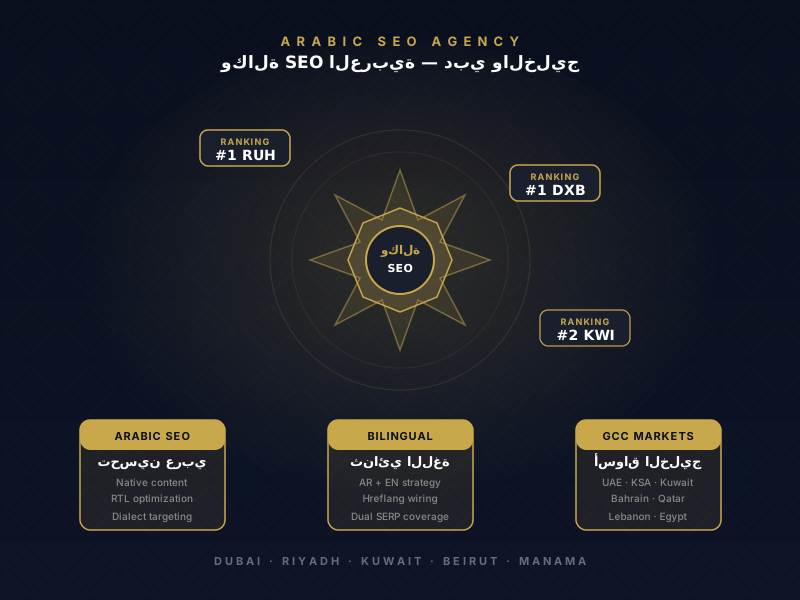
Code-switching is the part agencies miss most often. Queries such as شركة SEO دبي mix scripts inside a single search, and Google treats them as their own keywords with their own results page. You only find these by researching in Arabic, in-market — they do not appear in any English keyword tool export.
Arabic search is not one language either. A UAE buyer researching a service writes in Modern Standard Arabic; the same person looking for a nearby clinic writes in Gulf dialect, with different spellings for the same word. Often they abandon Arabic mid-query and type the brand or the technical term in English. An Arabic keyword list produced by translating an English one captures none of this, because it starts from the wrong question.
Then there is the architecture. Arabic runs right to left, but numerals, Latin brand names, and URLs do not, so a layout that was merely flipped breaks in ways that hurt Core Web Vitals and readability at once. Arabic pages need their own URLs, their own templates, and their own performance budget. Without reciprocal hreflang between each Arabic page and its English counterpart, Google serves the wrong version to the wrong searcher and the two compete instead of compounding.
The commercial argument is simpler than the technical one. In the Arabic keyword sets I map for UAE B2B clients, volumes run below the English equivalents and competition runs well below them — the diagnostic shows the split for your own terms. An Arabic SEO consultant works those queries because the competition is thin, the intent is high, and almost every competitor has left the Arabic side of their site unoptimised.
Want to see which Arabic queries your competitors have left open? The APEX Diagnostic maps them for your own domain.
Book a free Arabic SEO diagnosticMost agencies in Dubai will tell you they do Arabic SEO. Far fewer can show you an Arabic keyword map they built themselves. The gap between those two things is where budgets disappear, so it is worth asking a few direct questions before you sign anything.
Ask to see Arabic keyword research they produced, not a translated list. A genuine one contains queries an English tool could never surface: Gulf-dialect spellings, code-switched phrases that mix Arabic and Latin script, and the long-tail questions people actually type. If what comes back looks like your English keywords rendered in Arabic, it was translated.
Ask who writes the Arabic. Arabic written by a native speaker who understands your sector reads differently from machine output lightly edited afterwards, and Google has become good at telling them apart. Ask specifically whether the writer is a native speaker, and whether anyone reviews the result against the keyword map.
Ask how hreflang will be implemented. This is the single most common technical failure on bilingual UAE sites. Each Arabic page needs a reciprocal annotation pointing to its English counterpart and back again. Google’s own documentation on localized versions sets out the rules; a consultant who cannot describe them without looking it up has not done this before.
Ask what happens to your English rankings. Done properly, an Arabic layer adds a second addressable market without touching the first. Done badly — duplicate URLs, missing annotations, a subdomain nobody links to — the two versions compete and both lose. The answer you want describes how the versions will be kept separate, not a reassurance that it will be fine.
At upranked.io that work is scoped and managed by Sam directly, with specialist writers and developers she briefs herself. You deal with the person doing the thinking, not an account manager relaying it.
These three get used interchangeably in Dubai and they are not the same job. Which one you need depends on who is actually searching for what you sell.
Arabic SEO means building the Arabic side of your site as its own search property — native keyword research, Arabic content, RTL architecture. It suits businesses whose buyers search predominantly in Arabic: consumer services, healthcare, anything family-decided, and most of the Saudi market.
Bilingual SEO means running English and Arabic together, with each page pair annotated so Google serves the right one to the right searcher. This is what most UAE businesses need. The English side carries B2B, expat and professional-services demand; the Arabic side reaches a market where competition is thinner. See bilingual SEO for how the two are run in parallel.
Multilingual SEO adds languages beyond those two — Hindi, Urdu, Russian or Tagalog, depending on your customer base. It is the right answer less often than it is proposed. Every language added multiplies the content and the technical surface, so it is worth proving demand in your own search data before committing to a third.
If you are not sure which applies, that is exactly what the diagnostic answers: it shows the split between English and Arabic demand for your own terms, in your own sector, rather than applying a rule of thumb.
Keyword research run in Arabic, not translated from an English list — covering Modern Standard Arabic, Gulf dialect spellings, and the EN/AR code-switching patterns UAE buyers actually type.
Sam writes the Arabic content, working directly from the Arabic keyword research — nothing is machine-translated, and nothing is a word-for-word copy of the English page.
Real right-to-left implementation: RTL CSS, Arabic web fonts that do not break layout, Arabic URL structure, and Core Web Vitals measured on the Arabic templates rather than assumed from the English ones.
Reciprocal hreflang between every English and Arabic page pair so Google serves the right language, plus @graph JSON-LD on both versions with the Arabic business name, address, and phone in GCC format.
Authority links from Arabic-language publications and GCC Arabic business directories. Arabic pages need their own link profile — English backlinks do not carry the Arabic side on their own.
Arabic business name, categories, services, and posts on your Google Business Profile, so Arabic map and near-me searches in Dubai and Abu Dhabi surface your listing in the language the searcher used.
Your engagement runs through four phases: Audit, Position, Execute, Expand. Here is what each one delivers on the Arabic side of your site.
Arabic visibility audit: what you rank for in Arabic today, the RTL and hreflang faults blocking the rest, and the Arabic keyword gap against your competitors.
An Arabic keyword and content map tied to buyer intent, plus a 90-day roadmap in priority order — which Arabic pages get built first and why.
Arabic pages written and published, RTL and hreflang implemented and verified, bilingual schema deployed, Arabic link acquisition underway.
Arabic topic clusters extended into adjacent queries and new GCC cities, with monthly reporting on Arabic impressions, positions, and leads separately from English.
These are results from English-language search campaigns using the same process. Arabic-search case studies are in progress.
Medical — Dubai / UAE
Clicks 189 → 1,680 (8.9×) and average position 15 → 8.1 after an APEX SEO programme.
Quarter on quarter
Medical — Dubai / UAE
Clicks +137% and average position 24.9 → 18.5 after an APEX SEO programme.
Quarter on quarter
Industrial manufacturing — GCC
Average position 35.4 → 22.3 and impressions ×7 after an APEX SEO programme.
Quarter on quarter
Professional services — UK / Europe
Impressions 80,200 → 218,000 and average position 25.7 → 20.6 over one SEO engagement.
Year on year
Campaign in progress
Medical — Dubai / UAE
Impressions +43% and average position climbing from 60.7 to 55.1 in the first month of an ongoing engagement.
First 28 days
The APEX Diagnostic is free right now — a full audit of your Arabic and English search position, the keyword gap, and a 90-day roadmap, delivered by Sam with no commitment.
Ongoing work is quoted per engagement, based on what your site needs. Bilingual EN/AR coverage — Arabic keyword research, native Arabic content production, and Arabic link building — is included from the Authority tier upward.
Four things, in order. Native Arabic keyword research, done in-market rather than translated from an English list. Arabic content written by a native speaker against those queries. The technical layer — RTL templates, separate Arabic URLs, and reciprocal hreflang so Google serves the right version to the right searcher. Then authority work: Arabic-language links and an Arabic Google Business Profile. An agency that only does the first two leaves the rankings on the table; one that only does the third has nothing to rank.
Ask to see Arabic keyword research they produced themselves, and check it contains Gulf-dialect spellings and code-switched queries rather than translated English terms. Ask who writes the Arabic and whether they are a native speaker. Ask them to describe how reciprocal hreflang works without looking it up. And ask what happens to your English rankings — the right answer explains how the two versions are kept from competing, not a reassurance that it will be fine.
Arabic SEO builds the Arabic side of your site as its own search property. Bilingual SEO runs English and Arabic together, with each page pair annotated so Google serves the right one to the right searcher. Most UAE businesses need the second: the English side carries B2B, expat and professional-services demand, while the Arabic side reaches a market where competition is thinner. Which one fits your business comes out of your own search data.
upranked.io quotes per engagement rather than publishing tiers. Arabic SEO strategy, native keyword research and Arabic content production are scoped into the quote where your market calls for them, rather than held back for a higher tier. The APEX Diagnostic — a full technical audit, competitor gap analysis, keyword opportunity map, and 90-day roadmap — is free right now. Published Dubai agency pricing ranges from a few thousand dirhams a month for local packages to five figures for enterprise campaigns; upranked.io sits in the premium mid-market and is founder-led.
No. Translation moves words; Arabic SEO moves rankings. Arabic searchers use different query structures, different vocabulary, and a mix of Modern Standard Arabic, Gulf dialect, and Arabic-English code-switching depending on the topic. A translated page targets the English keyword set rendered in Arabic, which is rarely what anyone types. Arabic SEO starts with native Arabic keyword research and builds the content from those queries.
Arabic search results in the UAE are typically less contested than their English equivalents, so early movement often arrives faster than on the English side. Typically you see technical and indexation changes within weeks, ranking movement on long-tail Arabic queries within the first few months, and competitive commercial terms later — the timeline depends on your domain authority, sector, and how much Arabic content already exists.
An /ar/ subdirectory on your existing domain is enough for almost every business, and it is usually the better choice: the Arabic pages inherit the authority your domain has already earned instead of starting from zero on a second site. What matters is the implementation — a real RTL layout, unique Arabic URLs, reciprocal hreflang between each EN and AR page pair, and Arabic content that is not a mirror of the English.
It depends on the sector and the audience. The UAE is the most balanced market in the GCC: English carries much of the B2B, expat, and professional services demand, while Arabic is stronger for consumer, government-adjacent, healthcare, and family-decision queries. Saudi Arabia leans far more Arabic-first. The correct answer for your business comes from your own search data, not a rule of thumb — which is what the diagnostic measures.
Sam writes the Arabic content, working directly from the Arabic keyword research — nothing is machine-translated. Each page is reviewed against search intent before publication, and you review and approve everything before it goes live. If you have an in-house Arabic writer, we can instead supply the briefs, keyword targets, and structure and review the drafts.
Related Service
Already ranking in English and adding Arabic? That's bilingual SEO.
Running both languages brings its own problems — language routing, the hreflang cluster, and stopping your EN and AR pages competing for the same result.
Related Reading
Lebanon SEO Guide 2026 — Ranking in Beirut
Arabic-first search in a market with far less competition than the Gulf, and what a Beirut business should build before spending on ads.
Read the Beirut and Lebanon search guideRelated Reading
Arabic SEO Agency in Dubai & the UAE — What to Look For
The questions that separate a genuine Arabic SEO practice from a translation workflow, and the red flags worth walking away from.
How to vet an Arabic SEO agencyWritten & Overseen By
Founder & GCC SEO Strategist — upranked.io
Sam is a GCC SEO strategist whose whole focus is Arabic-language search — the queries, the RTL architecture, and the Gulf-dialect keyword sets English-first agencies never open. Your engagement is founder-led: the keyword research, architecture decisions, and content briefs come from Sam directly.
Book a free Arabic SEO diagnostic. We will audit your Arabic search position, find the queries your competitors have ignored, and show you what it takes to own them.