Medical — Dubai / UAE
Clicks 189 → 1,680 (8.9×) and average position 15 → 8.1 after an APEX SEO programme.
Clicks1891,680
Impressions34,500285,000
Avg. position158.1
Quarter on quarter
Most businesses do not need an AI strategy. They need one repetitive process to stop eating their week, or one set of customer questions to stop landing in a person’s inbox at midnight. upranked.io builds the specific thing — an assistant, an automation, a tool — and says plainly when AI is not the right answer.
Definition
What we build: AI assistants and chatbots for websites and WhatsApp; workflow automation for repetitive processes such as lead routing, quote generation and reporting; and custom AI tools and dashboards for document processing, data analysis and content workflows. What we do not build: AI models trained from scratch. Everything runs on existing models — OpenAI, Claude, Gemini — grounded in your own content and connected to your own systems.
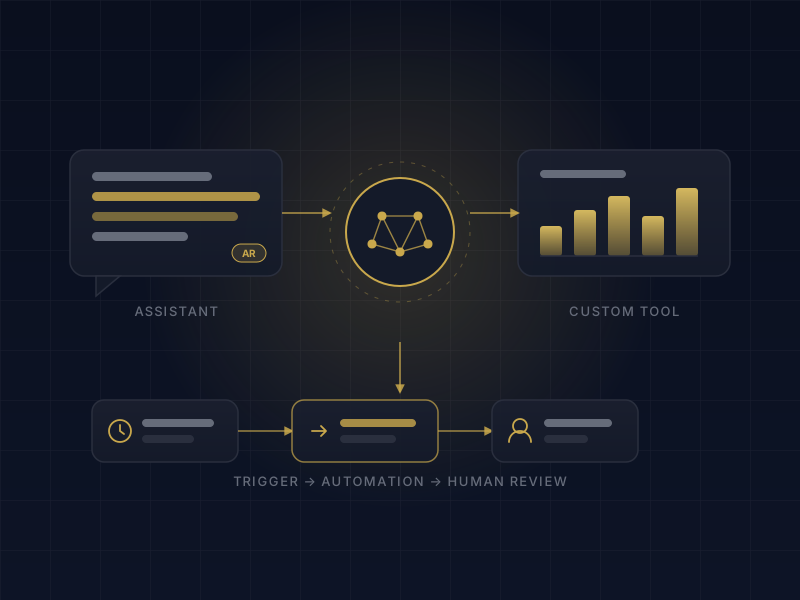
An AI assistant is worth building when the same questions arrive every day and a person has to answer them one at a time. It sits on your website, on WhatsApp, or both, and handles the repetitive half of the conversation: what you do, what is included, whether you cover their area, when you are open, what happens next.
The part that decides whether it is an asset or an embarrassment is grounding. The assistant answers from your own content — your pages, your service descriptions, your policies — rather than from what a general model assumes about your industry. When a question falls outside what it has been given, it says so and routes the conversation to a person instead of producing a confident guess that you then have to apologise for.
For GCC businesses the bilingual side is the differentiator. A customer writing in Arabic gets an Arabic reply, a customer writing in English gets English, and a customer who switches mid-conversation — which in the Gulf is normal, not an edge case — is followed rather than reset. The Arabic responses are reviewed rather than left to raw model output, because Arabic customer service is judged on tone as much as accuracy.
The questions your inbox gets every day — hours, service scope, what is included, what documents are needed — answered instantly from your own published content rather than from whatever the model happens to believe.
The assistant asks the questions your sales process already asks — budget range, timeline, location, what they actually need — and hands over a structured enquiry instead of a one-line "please call me".
Availability checked and a slot booked inside the conversation, so a customer enquiring at 11pm does not wait until the next working morning to get into your calendar.
The same assistant on your website and on WhatsApp, which in the GCC is where a large share of customer conversations actually happen — one set of answers, two places customers can reach you.
Every business carries a set of tasks that nobody chose and nobody enjoys: re-typing an enquiry into the CRM, rebuilding the same quote from the same template, assembling the Monday report out of three exports. Individually they take twenty minutes. Collectively they take the part of the week your team should have spent on work that only a person can do.
Automation starts from that problem, not from the technology. We look at the process as it actually runs — including the exceptions people handle manually and never mention — and automate the repetitive core while leaving the judgement calls with a human. The measure of success is hours returned and errors removed, not how much of the model you used.
Enquiries read, categorised and sent to the right person with the context already attached — instead of sitting in a shared inbox until somebody claims them.
A request turned into a draft quote using your own pricing rules and templates, ready for a human to check and send rather than rebuilt from scratch each time.
The weekly or monthly report that somebody currently assembles by hand from three systems, assembled automatically and delivered in the format your team already reads.
The copy-paste between your CRM, spreadsheets, accounting tool and website forms removed, so the same record does not get typed in three times and go stale in two of them.
Some problems are not a conversation and not a pipeline — they are a piece of software your business needs and nobody sells. A tool that reads the documents your operation runs on. An interface that lets a manager ask a question of your own data without opening a spreadsheet. A workflow that drafts repetitive commercial copy and stops at a human review step before anything goes out.
This is the AI-capability end of the tooling we build. If what you need is reporting, rank tracking, lead scoring or a growth dashboard, that lives on our custom business tools page — the distinction is that those tools track and report, while these ones read, analyse and generate.
Invoices, contracts, forms and PDFs read and turned into structured data your systems can use — with the extracted fields visible for checking rather than silently trusted.
Your own operational data queried in plain language, so the people who need an answer are not waiting on whoever owns the spreadsheet.
Drafting assistance for repetitive commercial content — product descriptions, response templates, listing copy — always with a human review step before anything is published.
Tools that watch your own pricing and stock data and surface what has moved, so decisions are made against current numbers rather than last month's export.
Four stages, in this order. Nothing is built before the scope is written down.
We start with the process, not the technology: what happens today, who does it, how long it takes, and where it breaks. That produces a written scope covering what the build will and will not do — and, where AI is the wrong tool for the problem, a recommendation to say so.
The first build is deliberately narrow: one assistant, or one process, at a fixed scope and a fixed price. You see the thing working against your real data before any wider commitment, and the pilot is judged against a success measure agreed before it starts.
The pilot is connected to the systems it needs, tested against the failure cases — not just the happy path — and handed over with documentation your team can use. Where the assistant should escalate to a person, that route is built and tested too.
Real usage shows what the scoping stage could not: the questions customers actually ask, the exceptions the automation meets. Those feed back into the build. What changes is agreed with you rather than absorbed quietly.
Who Does the Work
Sam scopes and manages every build, working with specialist developers she briefs directly. That means the person who defines what gets built is the person you deal with throughout — the scope, the decisions and the review are hers, and the implementation is handed to developers chosen for the specific stack the build needs.
Being specific about the limits is more useful to you than a page of possibility, and it is the fastest way to find out whether we are the right fit.
We build on existing models — OpenAI, Claude, Gemini and similar. The work is grounding, integration, guardrails and testing, not foundation-model training.
You are not buying a licence with our logo on it. If an off-the-shelf tool already solves your problem, the honest answer is to tell you to buy that tool.
Every piece of generated content passes a human review step before publication. Google's spam policies target scaled content produced primarily to manipulate rankings, and publishing unreviewed output is a risk to your site, not a saving.
These builds take repetitive work off people who currently do it by hand. Anyone promising headcount reduction as a deliverable is selling a business case they cannot stand behind.
On the content point, Google sets out its position in the Google Search spam policies — the issue is content produced at scale to manipulate rankings, not the use of AI in the process.
That is a different service from the builds on this page. Getting your business cited inside ChatGPT, Google AI Overviews, Perplexity and Gemini is search work, and it has its own pages.
These are results from English-language search campaigns run on the same APEX process — they are search results, not AI-build results. We publish AI project outcomes only once there are client-approved figures to show.
Medical — Dubai / UAE
Clicks 189 → 1,680 (8.9×) and average position 15 → 8.1 after an APEX SEO programme.
Quarter on quarter
Medical — Dubai / UAE
Clicks +137% and average position 24.9 → 18.5 after an APEX SEO programme.
Quarter on quarter
Industrial manufacturing — GCC
Average position 35.4 → 22.3 and impressions ×7 after an APEX SEO programme.
Quarter on quarter
Professional services — UK / Europe
Impressions 80,200 → 218,000 and average position 25.7 → 20.6 over one SEO engagement.
Year on year
Campaign in progress
Medical — Dubai / UAE
Impressions +43% and average position climbing from 60.7 to 55.1 in the first month of an ongoing engagement.
First 28 days
The APEX Diagnostic is free right now. For an AI project it means a working session on the process you want to change: what it costs you today, whether AI is the right tool for it, what would have to connect, and what a first pilot would cover — delivered by Sam, with no commitment.
AI builds are then scoped and priced per project. They are not sold at the monthly SEO retainer price, because the work between a single website assistant and an automation spanning four systems is not comparable. You get a fixed scope and a fixed price for the pilot before anything starts.
An AI assistant answers the questions your customers ask over and over — hours, pricing basics, service scope, availability, what documents they need — using your own content as the source. It can qualify an enquiry by asking the same questions your sales process asks, capture the answers, and hand a structured lead to whoever follows up. It can book appointments into your calendar. What it cannot do is invent an answer you have not given it: if the information is not in the content it is grounded in, it says so and passes the conversation to a person.
Yes, and for GCC businesses that is usually the point. The assistant detects the language the customer wrote in and replies in that language, including when a customer switches mid-conversation or mixes Arabic and English in the same message. Arabic responses are reviewed rather than left to raw model output, because tone and dialect matter more in Arabic customer service than a translation layer can handle.
It depends entirely on scope, and we will not quote a timeline before we know yours. A single-purpose website assistant grounded in content you already have is a much shorter build than an automation that has to read documents, write to your CRM, and handle exceptions. What we do commit to is telling you the expected shape of the work — what the pilot covers, what is deferred, and what has to be true before the build starts — in the scoping document, before you spend anything.
No. We build on existing models — OpenAI, Claude, Gemini and similar — and the engineering work goes into grounding them in your content, connecting them to your systems, setting the guardrails, and testing the failure cases. Training a model from scratch is a different business with a different cost base, and for the problems our clients bring us it would be the wrong answer even if we did it.
AI builds are scoped per project, not sold at the monthly SEO retainer price, because the work varies enormously between a single assistant and an automation that touches four systems. The starting point is the free APEX Diagnostic: we look at the process you want to change, tell you whether AI is the right tool for it, and scope a fixed-price pilot from there. If it is not the right tool, we will tell you that instead of selling you a build.
Usually yes. Anything with an API — CRMs, helpdesks, calendars, spreadsheets, accounting tools, e-commerce platforms — can normally be connected, and much of the value in an automation comes from exactly that. Older or closed systems with no API are the constraint to check early, which is why the scoping stage asks what you run before anything is designed. Where a direct connection is not possible we say so up front rather than working around it with something fragile.
Scoped & Managed By
Founder & Growth Strategist — upranked.io
Sam scopes and manages every build, working with specialist developers she briefs directly. Her starting question on an AI project is the same as on a search one: what does this change about how the business runs, and can we measure it afterwards.
Tell us the process that is costing your week or the questions filling your inbox. We will tell you whether AI is the right answer — and scope it if it is.