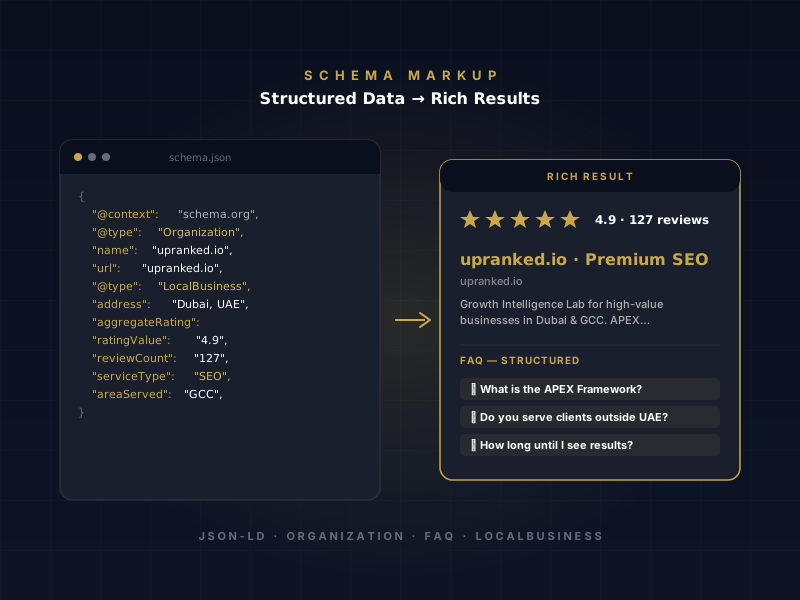
Schema markup is structured data you add to your website's code. It tells Google exactly what your pages are about: your business name, location, services, FAQs, products, and credentials.
Get it right and you unlock rich results. These are the enhanced listings with star ratings, FAQ dropdowns, pricing, and business hours. They dominate the top of the Google results page.
For GCC businesses, the gap is stark. Fewer than 8% of business websites in the UAE, Saudi Arabia, and Kuwait have any schema markup in place. Yet Google shows rich results for over 40% of commercial queries in these markets.
Why Schema Markup Matters More in the GCC Than Anywhere Else
The GCC search market gives schema users an unusual edge: almost nobody is doing it. In mature markets like the UK or US, more than 35% of commercial websites use structured data.
In the UAE the figure sits below 10%. In Saudi Arabia and Kuwait it is lower still. So a Dubai law firm, a Riyadh medical clinic, or a Kuwaiti e-commerce store can implement full schema markup and gain an immediate advantage.
Rich results are not decoration. Google's own data shows pages with rich results earn 40-60% higher click-through rates than standard blue links.
Strong technical SEO foundations make schema markup work. Without clean HTML, fast load times, and crawlable pages, even perfect structured data delivers nothing.
Schema Types Every GCC Business Should Implement
LocalBusiness and Organization Schema
LocalBusiness schema tells Google your business name, address, phone number, opening hours, geo-coordinates, and service area. If you operate across several emirates or countries, this schema drives local pack visibility and Google Business Profile integration.
Take a Dubai accounting firm. It should use LocalBusiness schema with its DMCC or DIFC address, a UAE phone format (+971), and service areas covering Dubai, Abu Dhabi, and Sharjah.
Organization schema is the parent type for businesses that operate at corporate level. It carries your logo, social media profiles, founding date, and corporate contact details.
Some GCC businesses run a holding company plus operating subsidiaries. Use Organization at corporate level and LocalBusiness at branch level. That gives Google a clear entity hierarchy it can read.
FAQPage Schema — The Highest-Impact Type for GCC Businesses
FAQPage schema is the most valuable schema type for Gulf businesses right now. It creates collapsible FAQ rich results inside search listings, and those take far more visual space than rival results.
It matters even more for AI search. FAQ structured data is the main signal that ChatGPT, Perplexity, and Google AI Overviews use to pull answers from your website and cite them.
Picture a Dubai property management company using FAQPage schema. It might add 'What are the RERA rules for rental increases in Dubai?'. That content is now set up for traditional rich results and for AI search citation.
Every service page and blog post on a GCC website should carry at least 3-5 FAQ entries with schema markup. The effort is small. The visibility gain is far larger.
Product and Service Schema
For GCC e-commerce businesses, Product schema unlocks the richest results Google offers. You get pricing, availability, star ratings, review counts, and merchant details in the listing itself.
A Kuwaiti electronics retailer that adds Product schema with AggregateRating and Offer properties will show prices in KWD, stock status, and customer ratings right in Google results.
Service schema does the same job for professional services firms across the GCC. A Riyadh IT consultancy can set out service types, service areas, price ranges, and provider credentials.
Pair it with Organization schema and you build a full entity profile. Google then uses that profile to match the business to relevant service queries.
MedicalOrganization and Physician Schema
Healthcare is one of the most competitive search verticals in the GCC. Medical schema markup gives you a decisive edge.
MedicalOrganization schema states clinic specialties, accepted insurance plans, medical services, and facility credentials. Physician schema adds each doctor's credentials and specializations. For more, see the full guide on medical SEO for Dubai clinics.
BreadcrumbList, Article, BlogPosting, and HowTo Schema
BreadcrumbList schema puts breadcrumb navigation in Google results. That context lifts CTR.
Article and BlogPosting schema are core to content marketing. They tell Google the publication date, author, headline, and publisher. HowTo schema creates step-by-step rich results for guides.
If you target SEO in the UAE in 2026, treat these schema types as the baseline.
How Schema Markup Drives AI Search Visibility
Schema markup is no longer only about Google's classic results. In 2026, structured data is the main route by which AI search platforms find, extract, and cite website information. That covers ChatGPT, Perplexity, and Google AI Overviews.
FAQPage schema hands them question-and-answer pairs they can quote word for word. Organization schema gives them entity details for attribution. Article schema supplies authority signals.
- Google AI Overviews pull FAQ answers straight from pages with FAQPage schema markup.
- ChatGPT's web browsing function favours structured data when it attributes sources.
- Perplexity uses Organization and LocalBusiness schema to spot authoritative local businesses.
- Voice search on Google Assistant and Siri leans on HowTo and FAQ schema for spoken answers.
- Schema adoption in the GCC is low. AI search citation is there for any business that implements structured data correctly.
Are you building an AI search optimization strategy for a GCC business? Schema markup is the technical foundation. Every other AEO and GEO tactic sits on top of it.
Common Schema Markup Mistakes on GCC Websites
- Duplicate Organization markup. On many GCC websites, both a plugin and a theme inject it, and the signals conflict.
- Incorrect address formatting. UAE addresses that use a PO Box with no geo-coordinates fail LocalBusiness schema validation.
- Missing or wrong currency codes. Product schema without ISO 4217 format blocks price rich results.
- Self-referencing review markup. Google penalises businesses that mark up their own testimonials as Review schema.
- Arabic content with English-language schema. That mismatch confuses search engines.
- Testing only with the schema validator and not the Rich Results Test. Valid schema and schema that earns rich results are two different things.
How to Test and Validate Your Schema Markup
Google gives you two testing tools. The Schema Markup Validator at validator.schema.org checks that your JSON-LD is written correctly. The Rich Results Test at search.google.com/test/rich-results checks whether your markup qualifies for real rich results. For search visibility, the Rich Results Test is the one that counts.
- 1Add JSON-LD schema to the head section of each page. JSON-LD is Google's recommended format.
- 2Test every page with Google's Rich Results Test.
- 3Fix all errors and deal with warnings. Warnings limit which enhancements appear.
- 4Watch the Enhancements section in Google Search Console for site-wide schema issues.
- 5Re-test after any website update, CMS migration, or theme change.
A GCC Schema Implementation Roadmap
- 1Week 1-2: Organization and LocalBusiness schema on the homepage and contact page. This sets your core entity with Google.
- 2Week 2-3: FAQPage schema on every service page and your top blog posts. This is the fastest path to rich results and AI search citation.
- 3Week 3-4: BreadcrumbList site-wide, plus Article or BlogPosting on all content pages.
- 4Week 4-6: Industry-specific schema. Product for e-commerce, MedicalOrganization for healthcare, ProfessionalService for consultancies.
- 5Ongoing: HowTo schema on guides, review monitoring, and quarterly Rich Results Test audits.
Frequently Asked Questions About Schema Markup for GCC Businesses
What is schema markup and why do GCC businesses need it?
Schema markup is a standard vocabulary of structured data, defined at schema.org. You embed it in your website's code to spell out page content for search engines.
GCC businesses need it because adoption in the UAE, Saudi Arabia, and Kuwait sits below 10%. Schema gives your listings visual features that raise click-through rates by 40-60% over plain text listings. It is also the technical prerequisite for AI search citation in ChatGPT, Perplexity, and Google AI Overviews.
Which schema types generate the most valuable rich results?
FAQPage schema has the biggest immediate impact. It creates collapsible FAQ dropdowns in results, and it is the main signal for AI search citation.
LocalBusiness is essential if you have a physical location. Product schema with pricing and ratings is critical for e-commerce. MedicalOrganization and Physician schema pay off in the Gulf's crowded healthcare sector. Best practice is to implement every relevant type, in priority order.
Does schema markup directly improve Google rankings?
Google says schema markup is not a direct ranking factor. The indirect impact is still large. Rich results lift click-through rates, and higher CTR is a positive engagement signal. Pages with rich results also take up more space in the SERP, pushing rivals down. For GCC businesses the edge is bigger still, because so few competitors use schema at all.
How do I implement schema markup on WordPress?
WordPress sites can add schema through plugins such as Rank Math or Yoast SEO. Both generate JSON-LD for basic types on their own.
That is rarely enough for GCC-specific needs, such as LocalBusiness with UAE address formatting or MedicalOrganization with DHA license numbers. Use a plugin for the baseline, then add custom JSON-LD blocks for business-specific data. Always validate with Google's Rich Results Test after a change.
Can schema markup help my business appear in ChatGPT and Perplexity?
Yes. AI search platforms treat structured data as a primary signal for finding citable content. FAQPage schema gives them question-and-answer pairs they can lift directly. Organization and LocalBusiness schema supply entity signals for recommendations.
So a GCC business with full schema markup and strong content is far more likely to be cited in AI answers. A competitor with the same content and no structured data is not.