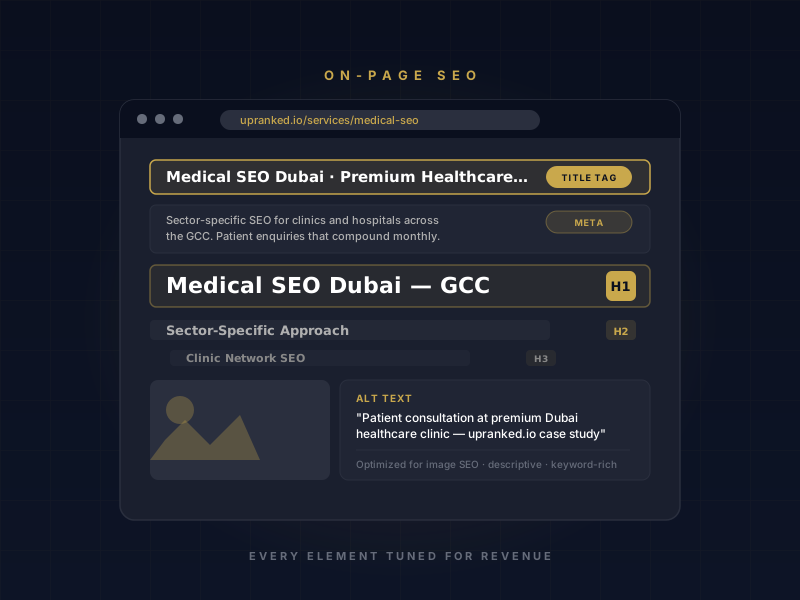
If you want to increase web rankings in Dubai, the fastest path is not more backlinks or more blog posts — it is fixing what is already on your pages. On-page SEO is the set of optimisations you control entirely: title tags, header structure, content depth, page speed, and the technical signals that tell Google exactly what each page is about and why it deserves to rank. In the UAE market, where competition for commercial keywords is intense but execution standards are inconsistent, getting on-page SEO right is often the single action that separates page-3 obscurity from page-1 visibility. Here are the 12 on-page SEO ranking factors that consistently move the needle for Dubai businesses in 2026.
Why On-Page SEO Matters More in Dubai Than You Think
Dubai has the GCC's most competitive search landscape, but the gap between businesses investing in off-site authority and those with clean on-page foundations is surprisingly wide. Many Dubai websites have strong domain authority from years of backlink investment — yet rank below newer competitors because their on-page signals are poorly optimised. Google's ranking algorithm weighs hundreds of factors, but on-page elements remain the most directly controllable and the fastest to fix.
The UAE market has specific on-page challenges that other markets do not: bilingual content requirements, RTL layout considerations for Arabic pages, and a mobile-first search audience that penalises slow pages harder than desktop-heavy Western markets.
1. Title Tags — The Single Most Important On-Page Signal
The title tag remains Google's strongest on-page ranking signal. It tells both the search engine and the searcher what the page is about. A well-written title tag includes the primary keyword near the beginning, stays under 60 characters to avoid truncation, and communicates a clear value proposition that earns the click.
For Dubai businesses, title tags need to include geographic modifiers — 'Dubai', 'UAE', or district-level modifiers like 'DIFC' or 'Dubai Marina' — because Google uses these to determine local search relevance. A title like 'Accounting Services' competes globally. A title like 'Corporate Accounting Services Dubai — DIFC and Business Bay' competes where it matters.
2. Meta Descriptions — Driving Click-Through Rate From the SERP
Meta descriptions do not directly affect rankings, but they directly affect click-through rate — and CTR is a user engagement signal that Google uses to evaluate page quality. A compelling meta description under 155 characters that includes the target keyword and a clear reason to click will consistently outperform the default snippet Google generates from page content.
In the Dubai market, where multiple businesses compete for the same SERP positions, include a specific differentiator or credibility signal — years in market, number of clients served, a specific methodology — rather than generic language. For bilingual sites, Arabic pages need independently written Arabic meta descriptions, not translations of the English version.
3. Header Hierarchy — H1 Through H4 Structure
Header tags create the content hierarchy that Google uses to understand page structure and topic coverage. Every page needs exactly one H1 that includes the primary keyword, followed by H2 sections for major topics and H3/H4 for subtopics. Pages with clear header structures consistently outrank pages with flat or missing header hierarchies.
A common mistake on UAE websites is using header tags for visual styling rather than semantic structure. For Dubai service pages, each H2 should target a distinct subtopic or long-tail variation of the primary keyword, creating a content architecture that captures multiple search intents on a single page.
4. Keyword Placement — Where Your Target Terms Appear
Google evaluates keyword placement, not just keyword presence. The primary keyword should appear in the title tag, H1, first 100 words of body content, at least one H2, the meta description, and the URL slug. Secondary keywords and semantic variations should appear naturally throughout the body content.
For on-page SEO in Dubai, keyword placement also means including Arabic keyword equivalents on bilingual pages with proper hreflang tagging. A page targeting 'corporate lawyer Dubai' should also have an Arabic counterpart targeting the equivalent Arabic search phrase — and both need independent on-page keyword optimisation.
5. Content Depth — Comprehensive Coverage Beats Thin Pages
Google's helpful content system rewards pages that comprehensively cover a topic from a genuine expertise perspective. For commercial pages in competitive markets like Dubai, service pages need to go beyond listing what you offer and address the questions, concerns, and decision criteria that buyers actually have. A 300-word service page will not rank against a 1,500-word page that covers the topic in depth.
Content depth in the UAE context means addressing the specific concerns of the local market: regulatory requirements, free zone versus mainland considerations, Arabic-language service availability, and the practical realities of doing business in the Emirates. For the broader content strategy, see what works in UAE SEO in 2026.
6. Internal Linking — The Most Underused On-Page Lever
Internal links distribute page authority across your site, help Google discover and understand your content hierarchy, and guide users to related pages. Every page should link to 3-5 other relevant pages using descriptive anchor text that includes relevant keywords. A strong internal linking structure turns individual pages into a coherent topical authority signal.
Most Dubai websites have weak internal linking — service pages that link only to the contact page, blog posts that link nowhere. Fixing internal linking is one of the fastest on-page wins: it requires no new content creation, no technical development, and no external resources. Simply auditing your existing pages and adding contextual internal links can produce measurable ranking improvements within 2-4 weeks.
7. Image Optimisation — Alt Text, Compression, and Format
Images affect rankings through three mechanisms: alt text provides keyword context and accessibility signals, file size affects page speed, and image format determines loading efficiency. Every image should have descriptive alt text, be compressed to the smallest file size that maintains quality, and be served in modern formats like WebP.
For Dubai businesses, image optimisation is particularly important because many UAE websites use large hero images and portfolio galleries served uncompressed. A single unoptimised image can add 2-3 seconds to page load time — enough to push Core Web Vitals into the poor range and trigger a ranking penalty.
8. Core Web Vitals — Page Speed as a Ranking Factor
Core Web Vitals — Largest Contentful Paint (LCP), Interaction to Next Paint (INP), and Cumulative Layout Shift (CLS) — are confirmed Google ranking factors. LCP should be under 2.5 seconds, INP under 200 milliseconds, and CLS under 0.1.
Dubai's mobile-first search audience makes Core Web Vitals especially critical. Over 70% of commercial searches in the UAE happen on mobile devices. Technical SEO audits that address Core Web Vitals — server response time, render-blocking resources, JavaScript execution — are foundational to any on-page SEO programme in the UAE.
9. Mobile Optimisation — Responsive Design Is the Minimum
Google uses mobile-first indexing, meaning it evaluates the mobile version of your page for ranking purposes. Responsive design is the baseline, but mobile optimisation goes further: tap targets must be appropriately sized, content must be readable without zooming, and navigation must work seamlessly on touch devices.
In the UAE, where smartphone penetration exceeds 95%, mobile optimisation is the primary consideration. Dubai businesses in hospitality, healthcare, and professional services frequently lose rankings because their service pages have desktop-oriented layouts that create poor mobile experiences.
10. URL Structure — Clean, Descriptive, and Keyword-Inclusive
URL structure affects rankings through keyword signals and user click behaviour. Best practice is short, lowercase, hyphen-separated URLs that include the primary keyword: '/corporate-tax-advisory-dubai/' rather than '/services/page-id-4837/'.
For bilingual Dubai websites, Arabic pages should use a consistent subdirectory structure ('/ar/service-name/') with transliterated URL slugs rather than Arabic characters. Avoid changing URLs on established pages without implementing proper 301 redirects — broken URLs are one of the most common causes of sudden ranking drops.
11. Structured Data — Schema Markup for Rich Results
Structured data (schema markup) tells Google what type of content is on your page and enables rich results — review stars, FAQ dropdowns, breadcrumb paths — that increase SERP visibility and CTR. For business websites, the most impactful schema types are Organization, LocalBusiness, FAQPage, Service, and BreadcrumbList.
Fewer than 10% of Dubai commercial websites have correctly implemented structured data. FAQPage schema on service pages generates FAQ rich results. For regulated sectors, types like MedicalOrganization provide additional trust signals. Our schema implementation service covers all of these for GCC businesses.
12. E-E-A-T Signals — Experience, Expertise, Authoritativeness, Trustworthiness
E-E-A-T is Google's framework for evaluating content quality. Experience signals include case studies and original data. Expertise signals include author credentials and professional qualifications. Authoritativeness comes from comprehensive coverage. Trustworthiness is reinforced by transparent business information and verifiable credentials.
For Dubai businesses in YMYL sectors — healthcare, legal, financial services — E-E-A-T is not optional. Practical steps include adding author bios with credentials, creating a detailed About page, publishing case studies with measurable outcomes, and ensuring every page has clear contact information and a physical address. For the full Dubai SEO strategy, see the complete guide.
Common On-Page SEO Mistakes on UAE Websites
- Duplicate title tags across multiple service pages — Google cannot differentiate pages that share the same title
- Missing or auto-generated meta descriptions — leaving Google to pull random sentences from the page
- No H1 tag or multiple H1 tags on a single page — confuses the primary topic signal
- Thin service pages with fewer than 300 words — consistently outranked by comprehensive content
- Images served as uncompressed PNG or JPEG at full resolution — fails Core Web Vitals LCP thresholds
- No internal links between related service pages — wastes topical authority
- Arabic pages that are machine-translated from English — detected by Google's language quality signals
- No structured data beyond basic meta tags — missing rich result opportunities
- Keyword-stuffed content that reads unnaturally — triggers Google's spam detection
Frequently Asked Questions: On-Page SEO in Dubai
How long does it take to see ranking improvements from on-page SEO changes?
On-page SEO changes typically produce measurable ranking movement within 2-6 weeks. Title tag and header optimisations are often reflected within days of Google recrawling the page. Content depth improvements take 3-6 weeks for full impact. This is significantly faster than off-page tactics like link building, which typically require 3-6 months. For Dubai businesses looking to increase web rankings quickly, on-page fixes are the highest-priority starting point.
What is the most important on-page SEO factor for Dubai businesses?
Title tags and content depth are the two highest-impact on-page factors. Title tags because they are the single strongest keyword signal. Content depth because the Dubai market is competitive enough that thin pages cannot rank for commercially valuable terms. For YMYL sectors like healthcare and legal, E-E-A-T signals are equally critical because Google applies additional quality scrutiny.
Do on-page SEO ranking factors differ between English and Arabic pages?
The core ranking factors are identical — Google evaluates title tags, headers, content depth, and page speed the same way for both languages. The implementation details differ: Arabic pages need RTL-compatible layouts, Arabic-specific keyword research, native Arabic content, and independent meta tags. See our guide to bilingual SEO for Arabic and English for the complete technical setup.
Should I optimise every page or focus on specific pages first?
Start with the pages that have the highest commercial value and the greatest ranking potential — typically your core service pages and pages already ranking on page 2. Use Google Search Console data to identify pages with high impressions but low CTR, as these are pages Google already considers relevant but that need on-page improvements to earn the click.
Can on-page SEO alone get my Dubai business to page 1?
For lower-competition and long-tail keywords, strong on-page SEO alone can achieve page-1 rankings, especially if competitors have weak on-page fundamentals. For high-competition head terms like 'lawyer Dubai' or 'SEO agency Dubai', on-page SEO is necessary but not sufficient — you also need off-page authority and sustained content investment. Build on-page foundations first, capture long-tail traffic, then layer authority-building tactics for the competitive terms.