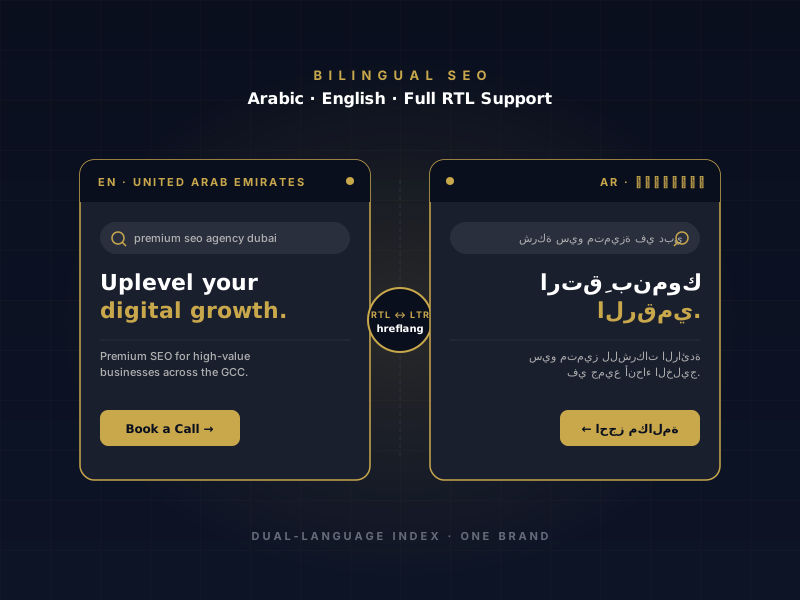
The UAE has two dominant search markets. English search is competitive, mature, and crowded. Arabic search is high-volume, commercially valuable, and almost entirely unoptimised by local businesses.
Think of a law firm serving both Emirati nationals and expat executives. It needs to appear for 'best corporate lawyer Dubai' in English. It also needs to appear for 'أفضل محامي شركات دبي' in Arabic.
Bilingual SEO in the UAE is not translation. It is a parallel search strategy. It needs a technically correct foundation and native-quality content in both languages. This guide explains how to build it.
Why Bilingual SEO Matters More in the UAE Than Almost Anywhere Else
The UAE has over 99% internet penetration and a population drawn from more than 200 nationalities. Arabic is the official language.
Emirati nationals are among the highest-spending consumers in any UAE sector, and they mostly search in Arabic. Expatriate professionals form the bulk of the workforce in Dubai and Abu Dhabi, and they search in English.
Target one language only and you shut out half of your potential organic audience by design.
The competitive gap is wide. English keywords like 'insurance broker Dubai' or 'accountant Abu Dhabi' pit you against well-funded rivals with years of SEO history.
Now take the Arabic equivalents, 'وسيط تأمين دبي' and 'محاسب أبوظبي'. In most sectors, competition runs at a fraction of the English level.
Arabic page-1 rankings that take 8–12 months in English are reachable in 2–4 months with properly structured bilingual content. The opportunity is real, it is closing, and it is still wide open in most UAE sectors.
- Arabic search volume in UAE healthcare, legal, financial, and real estate is substantial. It keeps growing as smartphone use nears 100%.
- Arabic-speaking Emirati and GCC nationals are the highest-spending buyers in most service categories.
- English-only websites are invisible to the Arabic search audience, however good the service or brand.
- Arabic SEO competition runs 3–8x lower than English in most UAE professional services sectors.
- Google's UAE results show localised Arabic listings for Arabic queries. That is a separate ranking pool your English pages never enter.
The Technical Foundation: How a Bilingual Website Must Be Built
Technical architecture comes before content or keywords. It decides whether Google can understand, index, and serve your Arabic and English pages correctly.
Get it wrong, as most UAE businesses have, and your bilingual investment brings in no organic traffic at all.
URL Architecture: Subdirectory vs Subdomain
This is the most consequential architectural choice in bilingual SEO. It is also the one most often got wrong.
A subdomain structure puts Arabic content at ar.yourdomain.com. A subdirectory structure puts it at yourdomain.com/ar/. Google treats subdomains as separate websites.
So the domain authority your main site has built, in backlinks, trust, and ranking history, does not carry over to a subdomain. Subdirectory architecture keeps all that authority on one domain. Every link your English site earns then supports your Arabic pages too.
So here is the right setup for a UAE business serving both audiences. Put English content at yourdomain.com/ and Arabic content at yourdomain.com/ar/. Every major bilingual publisher uses this architecture, and Google's international targeting guidelines recommend it outright.
Hreflang: The Technical Signal Google Uses to Serve the Right Language
Hreflang is an HTML attribute. It tells Google which language and regional version of a page to serve to which audience.
Without it, Google has to guess. It often guesses wrong, holding back one language version or treating both as duplicate content.
Correct hreflang for a UAE bilingual site needs four attributes on every page pair:
- en-AE for English content aimed at UAE users.
- ar-AE for Arabic content aimed at UAE Arabic speakers.
- ar-SA for Arabic content aimed at Saudi Arabia, if you target the KSA separately.
- x-default as the fallback for users whose language or region is not covered.
Each page pair must point both ways. The English page points to the Arabic version, and the Arabic page points back to the English one.
Missing that reciprocal tag is the most common hreflang error, and it makes Google ignore the whole signal. It is one of the first checks in every APEX Diagnostic for bilingual businesses.
RTL Technical Setup for Arabic Pages
Arabic reads right to left. A correct Arabic page needs the dir='rtl' attribute on the HTML element, Arabic-compatible fonts, and a mirrored layout. Navigation moves to the right, text aligns right, and images shift position.
Put Arabic text into a left-to-right layout and Arabic-speaking users bounce fast. That suppresses rankings for the Arabic version. Most UAE businesses that built Arabic pages without specialist help have this problem.
Arabic Keyword Research: Why You Cannot Just Translate English Keywords
Arabic keyword research is its own discipline. It is not English research applied to Arabic text.
Arabic speakers express the same intent differently. The vocabulary differs, the phrasing differs, and so does the balance between Gulf Arabic dialect and Modern Standard Arabic (MSA).
Take a Dubai clinic targeting 'dermatologist Dubai' in English. Translating that phrase will not capture Arabic search volume.
The Arabic landscape for the same intent includes 'طبيب جلدية دبي', 'دكتور جلد دبي', and 'افضل دكتور جلدية دبي', plus several dialect variants. Each carries different volume and different competition.
Native Arabic keyword research tells you which variants UAE patients really use, which carry commercial intent, and which you can win in a realistic timeframe.
- Gulf Arabic dialect differs a lot from MSA. Service sector searches often use colloquial Gulf terms that standard Arabic dictionaries do not carry.
- Arabic question queries are built differently from English ones. Content aimed at 'how to' in English needs a different structure in Arabic.
- Location modifiers behave differently. Adding 'دبي' to an Arabic query creates different competition than adding 'Dubai' in English.
- Arabic voice search on mobile follows conversational Gulf dialect. Content must serve both typed and spoken Arabic queries.
Content Strategy: What to Build in Arabic First
A common mistake is translating every English page at once to build an Arabic website. That is expensive and slow. It backfires if native speakers never review the Arabic.
Prioritise instead. Find the highest-value Arabic keyword opportunities, build native Arabic content for those first, then expand over time.
Some content almost always deserves Arabic-first production. That means your homepage, your core service pages, and your patient or client FAQ pages. It also means Google Business Profile content, plus any page where Arabic search volume beats English. Blog posts, case studies, and deep technical guides can wait for phase two.
The quality bar for Arabic content is not negotiable. Machine translation, including the newest AI tools, produces Arabic that Google flags as machine-generated and discounts in rankings.
Arabic-speaking users spot weak translation at once and leave. That bounce rate pushes rankings down further.
Only native-quality Arabic works. Have it written or reviewed by educated native speakers with knowledge of your field. That is the only route to rankings that hold.
In most GCC sectors, your English website competes against dozens of well-funded rivals. Your Arabic website competes against almost nobody. That gap will not last. The businesses building Arabic authority now are digging a moat.
Building Arabic Search Authority: Link Building for Bilingual Domains
Domain authority earned by your English site does help your Arabic pages. But dedicated Arabic link equity speeds Arabic rankings up sharply. Arabic backlinks pass direct authority to your Arabic pages. Look to Gulf publications, regional Arabic business directories, Arabic news platforms, and GCC industry associations.
Start Arabic link building in the UAE with your listings. Make sure your business appears correctly in Arabic across the main GCC business directories, Arabic review platforms, and sector Arabian directories.
Each consistent Arabic citation builds the entity signals Google uses to place your business in the Arabic search context. Editorial coverage in Arabic business publications carries the most authority, and UAE businesses chase it far too rarely.
The 6 Most Common Bilingual SEO Mistakes in UAE Websites
- 1Subdomain architecture. ar.domain.com splits authority from the main domain. Your Arabic pages start from zero, however strong the English site is.
- 2Missing or broken hreflang. This is the most common technical failure. Without correct reciprocal tags on every page pair, Google ignores the language signals completely.
- 3Machine-translated content. Google detects machine-made Arabic and discounts it. Users spot it at once and leave, and the bounce rate suppresses rankings further.
- 4No Arabic Google Business Profile. Many Arabic location searches surface GBP results, and an English-only profile misses that audience.
- 5Translated English keywords instead of native Arabic research. Literal translations miss how Arabic speakers really express the same intent.
- 6No Arabic link building. Lean only on English backlinks and your Arabic rankings will plateau well below their potential.
How Long Does Bilingual SEO Take to Show Results in the UAE?
Arabic pages are usually indexed within 2–4 weeks of correct setup and publication. First Arabic rankings on page 3–5 often show within 6–10 weeks for well-targeted, natively written content.
Page-1 Arabic rankings in competitive UAE sectors usually take 3–5 months. That is measurably faster than the English equivalent, because competition is lower.
An Arabic SEO programme compounds over time, just as English SEO does. The difference is the starting point. In most sectors, you build Arabic authority from a near-zero competitive baseline.
Want to see how bilingual SEO fits a full Arabic content and link-building strategy? See the Arabic SEO agency guide for Dubai and UAE businesses.
Frequently Asked Questions: Bilingual SEO in the UAE and GCC
What is bilingual SEO and how is it different from standard SEO?
Bilingual SEO means optimising one website to rank in two or more languages at once. In the UAE that means Arabic and English. It takes correct technical architecture, native content in each language, and a separate link-building programme for each language's ranking ecosystem. It differs from standard SEO in three ways: it needs hreflang, it needs subdirectory URLs to keep domain authority together, and it needs native keyword research in each language rather than translation.
Should I use a subdomain or subdirectory for my Arabic website?
Subdirectory, always. yourdomain.com/ar/ keeps your domain authority in one place. Every backlink your English site earns then supports your Arabic pages.
ar.yourdomain.com looks like a separate domain to Google. Your Arabic site starts at zero authority, however strong your English domain is.
There is one exception. If the Arabic version targets a completely different geographic market under a separate brand, a subdomain can make sense. That is rare for UAE businesses.
Does Arabic SEO require a separate Google Search Console property?
With subdirectory architecture at domain.com/ar/, your Arabic pages sit under the same domain property in GSC as your English pages. You can filter by URL prefix to analyse Arabic performance, or set up a URL prefix property for domain.com/ar/.
With subdomain architecture at ar.domain.com, you need a separate GSC property. Either way, track Arabic and English separately across clicks, impressions, CTR, and position. That is how you measure bilingual ROI.
How much does bilingual SEO cost in Dubai?
A real bilingual SEO programme in Dubai starts with two one-time jobs: a technical audit and hreflang implementation. After that comes an ongoing retainer for Arabic and English content, link building, and tracking. Entry-level bilingual retainers from UAE specialist agencies start at AED 5,000–7,000 per month. Full programmes cover native Arabic content, Arabic link building, and multi-market GCC targeting. Those usually run AED 8,000–18,000 per month, depending on sector and content volume.
Can I target both Saudi Arabia and UAE with one bilingual website?
Yes. The technical approach does not change. Use subdirectory architecture with hreflang tags set to ar-AE for UAE Arabic content and ar-SA for Saudi Arabic content.
Content strategy shifts a little. Account for Gulf dialect differences between UAE and Saudi audiences in your high-volume pages. The structural foundation stays identical.
For businesses serving the wider GCC, one well-built bilingual domain can rank across all six Gulf markets.