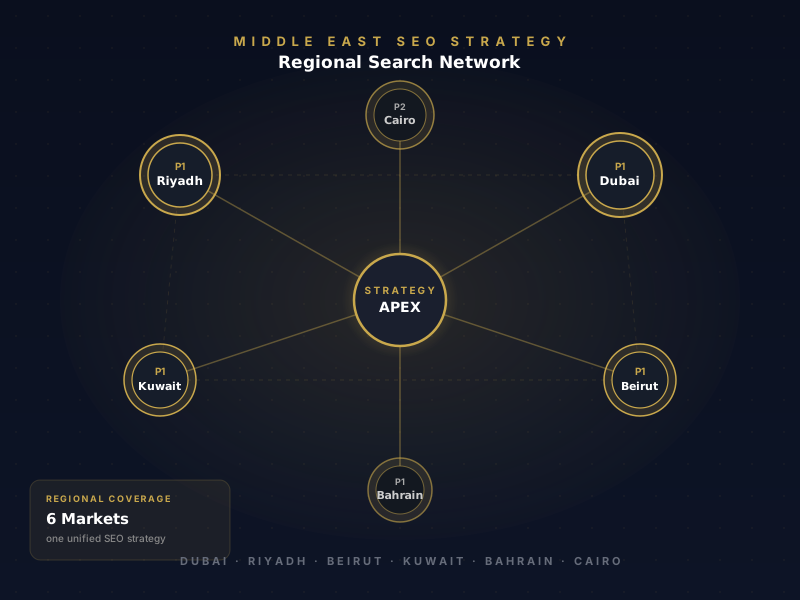
Ranking across the Middle East requires an SEO strategy built for six distinct markets, not one. The GCC — UAE, Saudi Arabia, Kuwait, Bahrain, Qatar, and Oman — shares a common language family and a Google-dominated search landscape, but the similarities end there. Search behaviour, language preference, competition density, and commercial intent differ by country and by city. The businesses that win organic visibility across the GCC in 2026 are the ones that build a unified strategic framework with market-specific execution — right keyword sets, right language splits, right local signals for each country.
The GCC Search Landscape: Why One Strategy Does Not Fit All
The Gulf Cooperation Council countries collectively represent over 60 million people, with internet penetration rates above 95%. Google dominates search across all six countries, holding over 96% market share. But the way people search — the language they use, the queries they type, the local intent signals they trigger — varies significantly. A search for professional services in Dubai looks nothing like the same search in Riyadh or Kuwait City.
- UAE search traffic splits roughly 50/50 between English and Arabic — the only GCC market where English dominates in certain commercial verticals
- Saudi Arabia is 80%+ Arabic-first in commercial search
- Kuwait has a small, concentrated population with extremely high purchasing power and almost no competitive SEO
- Bahrain's fintech and professional services sector shows the highest AI tool adoption per capita in the GCC
- Qatar and Oman have niche but valuable search markets with specific regulatory and cultural considerations
UAE: Dubai and Abu Dhabi — Highest Competition, Bilingual Requirements
The UAE is the most competitive SEO market in the GCC. Dubai in particular has attracted international agencies and global brands that have invested in organic search for years. Despite this, most commercial sectors still have significant SEO gaps — businesses have invested in paid search while neglecting organic. Abu Dhabi is even less contested, with private sector SEO being genuinely sparse.
What makes UAE SEO distinct is the bilingual requirement. The country's population is roughly 90% expatriate, with English as the lingua franca for business. But Arabic-speaking audiences represent some of the highest-value searchers. A bilingual SEO strategy covering both Arabic and English is the baseline. For the Dubai-specific approach, see the Dubai SEO guide for 2026.
- Target both English and Arabic keyword sets — a single-language strategy misses roughly half the UAE market
- Abu Dhabi has lower competition than Dubai in almost every sector — faster ranking timelines
- E-E-A-T signals carry significant weight in UAE medical, legal, and financial verticals
- UAE-based businesses benefit from strong local link opportunities through government portals and free zone directories
Free Audit
Get Your Free GCC SEO Audit
Book the free APEX Diagnostic. Sam maps your visibility in each GCC market, in Arabic and English, and names the one worth attacking first — delivered as a PDF within 5 working days, with a live walkthrough.
Prefer WhatsApp? Message Sam directly
Saudi Arabia: Riyadh and Jeddah — Vision 2030 and the Arabic-First Market
Saudi Arabia is the largest economy in the GCC and the most underserved by SEO. Vision 2030 has accelerated digital transformation across every sector, and the resulting surge in search volume has far outpaced the supply of optimised content. The window to build organic authority in Saudi Arabia is closing, but it is still wide open in most verticals.
The critical difference: Saudi Arabia is an Arabic-first search market. Over 80% of commercial search queries happen in Arabic, and those queries carry the highest commercial intent. An Arabic SEO strategy built specifically for Gulf Arabic dialect is the foundation. For the full breakdown, see the Riyadh SEO guide.
- Arabic-first keyword research using Gulf Arabic dialect is non-negotiable
- Vision 2030 sectors — tourism, entertainment, healthcare, education — have the highest search volume growth and lowest competition
- Saudi Arabia has specific content sensitivities around religious, cultural, and regulatory topics
- Google.com.sa local pack results require Saudi-specific Google Business Profile setup
Kuwait: Small Market, Concentrated Opportunity
Kuwait has a population of roughly 4.3 million and one of the highest GDP per capita figures in the world. The search market is small in absolute terms but extraordinarily concentrated — a handful of rankings in the right sectors can capture a disproportionate share of a wealthy, commercially active audience. SEO competition in Kuwait is almost non-existent outside a few sectors like real estate and automotive.
For businesses already established in Dubai or Riyadh, Kuwait represents a high-ROI expansion market where rankings come faster and cheaper. The full breakdown is in the Kuwait SEO guide.
Bahrain: Fintech Hub with Emerging SEO Potential
Bahrain has positioned itself as the GCC's fintech and startup hub. The search market is small — under 2 million population — but the audience is highly educated and commercially active. Bahrain has one of the highest AI tool adoption rates per capita in the GCC, making it a priority market for businesses building AEO and GEO presence.
SEO competition in Bahrain is genuinely minimal. Most businesses rely entirely on referrals and paid advertising. Organic search is an untapped channel where even basic optimisation delivers significant visibility gains within weeks.
Qatar and Oman: Niche Markets Worth Watching
Qatar's post-World Cup digital infrastructure investments have expanded the search market, particularly in hospitality, real estate, and financial services. Oman is the least digitally mature GCC market for SEO purposes, but government-led digitisation under Oman Vision 2040 is creating new search demand. Both markets reward Arabic-first content strategies and benefit from businesses that establish organic authority early.
Bilingual SEO Strategy: Why Both Languages Matter
- UAE: roughly 50/50 English and Arabic for commercial queries — both are essential
- Saudi Arabia: 80%+ Arabic — English content serves a niche expatriate audience
- Kuwait: Arabic-dominant with English loanwords in younger demographics
- Bahrain: bilingual with a slight Arabic lean
- Qatar: Arabic-dominant for local services, English for international sectors
- Oman: Arabic-first with limited English search volume outside tourism
The most important principle: translation is not bilingual SEO. Each language version needs its own keyword research, content architecture, and on-page optimisation. For the full methodology, see the bilingual SEO guide.
Running one strategy across several GCC markets is where most regional campaigns lose money. The free APEX Diagnostic maps where you currently rank in each market, in both languages, and shows which market is worth attacking first — [book one here](/contact/).
Domain and URL Strategy for Regional GCC SEO
- Subdirectories (example.com/ae/, example.com/sa/) — recommended for most businesses. Consolidates domain authority and is simplest to manage
- Subdomains (ae.example.com) — splits domain authority without meaningful ranking benefit
- Country-code TLDs (.ae, .sa, .kw) — strongest local signal but fragments authority. Only justified when regulatory requirements demand it
- Language subdirectories (/en/, /ar/) combined with country subdirectories — cleanest architecture for multi-market, multi-language GCC SEO
Hreflang implementation is critical regardless of structure. Every page targeting a specific country and language combination needs correct hreflang annotations pointing to all alternate versions. Errors in hreflang are one of the most common technical SEO failures in multi-market GCC websites. Our Arabic SEO service covers the Arabic half of that in depth.
Google Business Profile Across Multiple GCC Markets
Google Business Profile is the most important local SEO asset for multi-market GCC businesses. Each physical location needs its own verified GBP listing optimised for its specific market. A Dubai listing does not generate visibility in Riyadh or Kuwait City.
- Verify a separate GBP listing for every physical office in each GCC country
- Complete every listing in both Arabic and English where the market is bilingual
- Build market-specific review profiles — reviews from Saudi clients strengthen Riyadh visibility
- Post regularly to each GBP listing with market-relevant content
- Monitor and respond to reviews in the language they are posted
Cultural and Search Behaviour Differences Across the GCC
- Ramadan shifts search patterns significantly — food and retail searches spike during evening hours while B2B search drops
- Mobile-first is the default — GCC countries have among the highest mobile internet usage rates globally
- Social proof carries exceptional weight — GCC consumers rely heavily on reviews and community recommendations
- Seasonal patterns tied to national days, religious holidays, and summer travel create predictable traffic spikes
- Visual content expectations should reflect local cultural norms, including modest representation in healthcare and lifestyle sectors
Common Mistakes When Targeting Multiple Middle East Markets
- 1Treating the GCC as one market — using the same keywords and content for Dubai, Riyadh, and Kuwait
- 2Machine-translating English content into Arabic — it does not rank, does not convert, and damages brand perception
- 3Ignoring hreflang tags — Google cannot determine which version to serve in which market
- 4Using a single Google Business Profile for multiple markets — each market needs its own verified listing
- 5Applying Western content calendars — publishing schedules that ignore Ramadan, Eid, and national days
- 6Building links from irrelevant international sources instead of GCC-specific local publications
- 7Neglecting Arabic E-E-A-T signals — Arabic pages need their own author credentials and trust signals
Frequently Asked Questions: Middle East SEO Strategy
How long does it take to rank across multiple GCC markets?
In low-competition markets like Kuwait, Bahrain, and Oman, rankings for commercial terms can appear within 4 to 8 weeks. In Dubai and Riyadh, competitive terms take 3 to 6 months. A multi-market strategy should expect 6 to 12 months for comprehensive GCC visibility, with early wins in smaller markets arriving within the first quarter.
Do I need separate websites for each GCC country?
No. A single domain with subdirectory structure and correct hreflang implementation is the most effective approach for most businesses. Separate ccTLD websites are only justified when regulatory requirements demand a local domain or when the business operates as legally separate entities per country.
Should I prioritise Arabic or English content for GCC SEO?
It depends on the market. In the UAE, both languages are essential. In Saudi Arabia and Kuwait, Arabic-first is the only viable approach. In Bahrain and Qatar, a bilingual strategy with a slight Arabic lean covers the most ground. The most common mistake is defaulting to English because it is easier to produce — that approach leaves the majority of Saudi, Kuwaiti, and Qatari search traffic untouched.
What is the biggest SEO opportunity in the Middle East right now?
Arabic-language content optimisation across the GCC. The volume of Arabic search queries is growing faster than the supply of optimised Arabic content. Vision 2030 in Saudi Arabia is driving particular growth in healthcare, tourism, education, and financial services. Businesses that build Arabic organic authority now will hold positions that become exponentially harder to challenge as competition catches up.
How does Google Business Profile work across different GCC countries?
Google treats each country's local search results independently. A GBP verified in Dubai generates visibility only in the UAE — it will not surface in Saudi Arabia, Kuwait, or Bahrain. Businesses operating across multiple GCC markets need a verified listing for every physical location in each country, each optimised in the appropriate language. The local SEO fundamentals apply everywhere, but execution details must be tailored to each country.