If you have asked an agency for Arabic SEO services in Dubai and received a vague scope with a monthly retainer, you are not alone. Arabic SEO is one of the most poorly defined services in the Dubai digital marketing market. This guide explains exactly what a legitimate Arabic SEO service covers, what each component delivers, and how to evaluate whether what you are buying will actually move your rankings.
What Arabic SEO Services Should Include
A complete Arabic SEO service covers six core areas. Most agencies only deliver two or three. Understanding the full scope helps you ask the right questions and hold providers accountable. For context on what an Arabic SEO agency in Dubai should look like overall — including how to evaluate their team, process, and results — the full agency guide covers each signal in detail.
1. Native Arabic Keyword Research
Arabic keyword research starts with how Arabic speakers actually search — not translations of English keywords. GCC users search using Gulf Arabic dialect, brand abbreviations, and colloquial terms that have no direct English equivalent. A proper keyword map for Dubai includes separate volume data for UAE Arabic search, Saudi Arabic search, and broader GCC Arabic search, because intent and vocabulary differ by country. This research typically identifies 80–150 target keywords per service area.
2. Bilingual Technical SEO
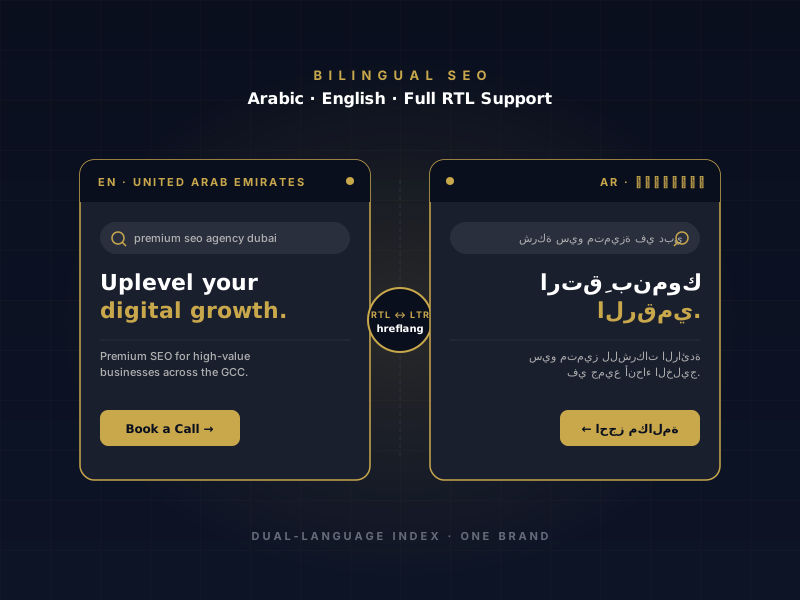
Running an English and Arabic website requires technical configuration that most agencies miss — full requirements are in the Google hreflang documentation. Key elements include: correct hreflang implementation (telling Google which page serves which language-country combination), HTML dir='rtl' attribute on Arabic pages, bidirectional text handling in meta descriptions, and mobile performance testing on Arabic page renders. Errors in any of these can cause Arabic pages to cannibalise English rankings or fail to index entirely.
3. Arabic Content Production
Arabic landing pages, blog posts, and service descriptions must be written by human writers with GCC market expertise — not generated by AI or translated from English. Google can detect low-quality translated content and ranks it poorly. More importantly, Gulf Arabic speakers can immediately identify generic content, which increases bounce rate and kills conversions. Expect 800–2000 words per landing page for competitive keywords.
4. On-Page Optimisation for Arabic Pages
Each Arabic page needs on-page optimisation — including optimised title tags (Arabic, within 60 characters), meta descriptions (Arabic, within 155 characters), H1/H2 structure using target Arabic keywords, internal links connecting Arabic pages to each other and to relevant English pages, and schema markup where applicable. This is not automatically handled by translating your English on-page optimisation — Arabic keyword density, placement, and structure need to be configured separately.
5. Arabic Link Building
Arabic-language backlinks from Arabic-language websites are a separate link building channel from English link building. Links from Arabic news sites, GCC business directories, Arabic blogs, and regional publications carry different authority signals than English links. A Dubai business competing for Arabic search traffic needs Arabic-domain backlinks to build topical authority for Arabic queries. This is often the most neglected part of Arabic SEO because it requires regional relationships and Arabic outreach capability.
6. GCC-Specific Rank Tracking and Reporting
Arabic keyword rankings must be tracked separately for each GCC country — UAE, Saudi Arabia, Kuwait, Bahrain, Qatar — because rankings differ significantly by location. Monthly reporting should show keyword rankings by country, organic traffic segmented by language, and conversion attribution from Arabic landing pages. Without country-level tracking, it is impossible to know whether your Arabic SEO investment is generating ROI.
Realistic Results Timeline for Arabic SEO in Dubai
- Month 1–2: Technical fixes, keyword map, first Arabic landing pages published
- Month 3–4: Pages indexed, initial rankings appear (typically page 5–8)
- Month 5–6: Rankings improve to page 2–3 for mid-competition keywords
- Month 9–12: Page 1 rankings for target keywords, measurable Arabic organic traffic
- Month 12+: Compounding returns as domain authority builds
What Arabic SEO Does Not Include
Arabic SEO does not mean running Google Ads in Arabic. Paid Arabic search and organic Arabic SEO are separate channels with separate budgets, strategies, and timelines. Arabic SEO also does not cover social media management in Arabic, Arabic email marketing, or WhatsApp marketing — these are distinct services that may complement SEO but are not part of an organic search strategy.
Frequently Asked Questions
Does Arabic SEO work for B2B companies or only B2C?
Arabic SEO works for both — see how we approach business SEO in the GCC. B2B buyers in GCC countries frequently research in Arabic before reaching out in English, particularly in sectors like healthcare, legal services, construction, logistics, and manufacturing. Capturing the Arabic research phase puts your brand in consideration before competitors who only target English-language search.
Do I need a separate Arabic domain or subdomain?
Not necessarily. The best structure depends on your current domain authority and technical setup. Many Dubai businesses use subdirectories (yourdomain.com/ar/) which consolidates authority onto one domain. Subdomains and separate domains can also work but typically require more link building to build independent authority. The right choice depends on a technical audit of your specific site.
How do I know if Arabic SEO is worth it for my business?
If your customers include Arabic speakers — or if you want to expand into Saudi Arabia, Kuwait, or other GCC markets — Arabic SEO almost certainly has a positive ROI. The Arabic search market in the GCC is large, competition for Arabic keywords is significantly lower than English in most industries, and ranking Arabic pages is genuinely achievable within 12 months with proper investment.